Posts

Showing posts with the label Wm. R. Staats & Co.

Francis I. duPont & Co. Genealogy: Part XIV
Image
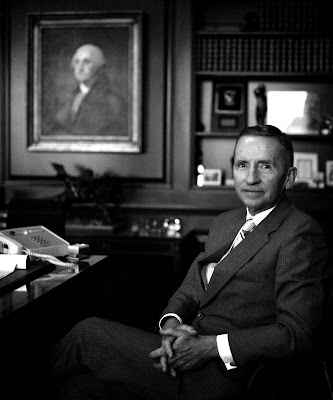
William R. Staats & Co., Continued The Entry of Ross Perot, Continued Ross Perot in his office, by Allan Warren. In January 1971, duPont family members led by Anthony duPont, Edmond's son, tried to withdraw their capital from the firm. Perot was outraged. He said, "[The duPont family] knew I wanted to do this thing in the national interest. They would have been wiped out if I hadn't come in, but when I did they looked on me as someone pouring money into a funnel so they could take it out at the bottom." As The New York Times stated, "The Perot group, of course, had no intention of keeping its own money in the firm, inasmuch as the group's funds had kept duPont afloat. The duPont family interests and other principals would not have had anything to consider pulling out, had the Perot group not prevented the firm's failure." The NYSE leadership became intermediaries in the conflict and tried to impress upon the duPont family interests the...

Francis I. duPont & Co. Genealogy: Part XII

Image
William R. Staats & Co., Continued William R. Staats & Co. (1951) William R. Staats & Co., Inc. In 1947, Jardine stepped down from the presidency and became chairman of the board. He was succeeded by Donald Royce, a former vice president and manager of the southern California branch of Blyth & Co., Inc. , a San Francisco firm founded in 1914. In 1951, William R. Staats & Co., Inc. became a partnership, and Jardine, Royce and other Staats executives became general partners. (Jardine died in 1956 but his son, John Earle Jardine, Jr. (1899-1972), joined the firm in 1922.) By that time, the firm has offices in six California cities and Phoenix, Arizona, and a correspondent relationship with Clark, Dodge & Co. of New York. In 1963, Staats & Co. took over the San Francisco firm of Hooker and Fay, Inc. (founded 1938) and Charles W. Fay, the president of Hooker & Fay, joined the firm. Staats & Co. went back to being a corporation by 1964, the year it en...

Francis I. duPont & Co. Genealogy: Part XI

Image
William R. Staats & Co. Ford Motor Company Syndicate #76 Founded 1888*, Pasadena, California Origins William R. Staats (1867-1928) was the descendant of Major Abraham Staats (1618-1683), a Dutch immigrant who came to the New World in 1642, and the son of a minister. In 1886, Staats traveled to Pasadena, CA from his home in Glastonbury, CT. Just 19 years old, Staats had been suffering from a lung illness for three years and had tried and failed to regain his health in Florida. His parents were advised by Dr. Alfred Loomis, a New York lung specialist, that he might survive his illness if he made it to California. Staat's former teacher at the Wesleyan Academy (MA), Prof. Charles M. Parker, had traveled to California to recover his own health and had settled in Pasadena. With the financial assistance of his father's congregation, Staats made the journey to Pasadena and boarded with a Mr. Meharry, who was secretary of the Lake Vineyard Land and Water Company at which Parke...

Francis I. duPont & Co. Genealogy: Part X

Image
Glore, Forgan & Co., Continued Glore, Forgan & Co. (founded 1937, Chicago) During the mid-20th century, Glore, Forgan & Co. went through a generational transition, and, like many other banking partnerships, it did so under the shadow of a worldwide conflict. Like many in the investment community, the partners of Glore, Forgan & Co. also interrupted their work to serve in World War II. Charles Glore, who had also served in World War I under General Pershing, became the Illinois chairman of the British War Relief Society . J. Russell Forgan served in the Office of Strategic Services "collecting, assessing and disseminating information about German defenses and troop positions before the Normandy landings." Charles F. Glore died in 1950, but his two sons  –  Charles F. Glore, Jr. (1920-1976), who studied at Babson Institute, and Robert Hixon Glore (1923-2008), a Wharton graduate (1948)  –  joined Glore, Forgan & Co. in the postwar period. J...