Posts

Francis I. duPont & Co. Genealogy: Part XVII

Image
Walston & Co., Inc., Continued Death of the Founder (1964) Walston & Co., Inc. suffered a terrible blow on May 5, 1964, when its founder, Vernon Walston, committed suicide at his office at 72 Wall Street. On his way to work that morning, he had told his chauffeur, Gustav Puigdollers, that he was going to kill himself. When they got to the office, Puigdollers went to call Walston's wife. Walston was a big-game hunter and his office was full of trophies from his hunting trips and a double barreled shotgun. Walston went into his office, took the shotgun and shot himself through the mouth. No note was left, but his associated noted that Walston has been looking "despondent" and speaking "incoherently." According to The New York Times , the day before Walston killed himself, he had a telephone interview with a Times reporter where, "speaking in an agitated voice, he expressed great dissatisfaction with the amount of stock the Walston firm was...
Francis I. duPont & Co. Genealogy: Part XVIII

Walston & Co., Inc., Continued DuPont Walston (1973) Despite the positive prognosis of the firm's financials in 1964, the firm soon ran into difficult straits. In 1968, Glenn Miller had organized the common stock offering of Four Seasons Nursing Centers of America, "an Oklahoma-based corporation that built, leased and operated numerous nursing homes." When Four Seasons went bankrupt two years later, Miller and Gordon H. McCollum, another vice president and Four Seasons director, were indicted for fraud. They were charged in federal court for creating "fraudulently high earnings reports to dupe investors into paying artificially high stock prices for Four Seasons." The bankruptcy cost investors $200 million and was considered "One of the largest fraud cases ever uncovered." Miller and McCollum plead guilty in 1973. Even though Walston & Co. was not named as a defendant in the fraud case, the Four Seasons debacle put the firm in a diffi...

Francis I. duPont & Co. Genealogy: Part XVI

Image
Walston & Co., Inc., Continued Walston, Hoffman & Goodwin (1941) Walston & Co. (1953) Walston & Co., Inc. (1955) These events seem not to have had an effect on the firm's makeup because in 1941, when the firm changed its name to Walston, Hoffman & Goodwin, Claire Giannini Hoffman herself became a limited partner of the new firm. Prior to joining Walston & Co., her husband, Clifford Hoffman , had been a partner at Schwabacher & Co. A Stanford graduate (1929) and former college football star, Hoffman (also known as "Biff") became a partner in 1936. Claire V. Goodwin , who was also a sportsman (baseball), had previously been associated with Wm. Cavalier & Co., and Oakland firm, and McDonnell & Co. Emulating the Bank of America branch network, Walston, Hoffman & Goodwin created an extensive branch office network of its own. According to Alec Benn, "Vern Walston had located Walston & Co,'s offices near those of Ban...

Francis I. duPont & Co. Genealogy: Part XV

Image
Walston & Co., Inc. Ford Motor Company Syndicate #52 Founded 1932, San Francisco Origins Vernon C. Walston (1906-1964) was born in Oklahoma. His father, William H. Walston, was a farmer and Kentucky native. By 1920, Walston's family moved to California, where his father ran a laundry and dry cleaner and his mother, Alvina, a Kansas native, worked as manager. Walston was raised in California, where he was educated in public schools. When Walston was about 18 years old, he became a clerk in a branch office of the Bank of Italy . There, he eventually became the secretary and a protégé of Amadeo Peitro/Peter (A.P.) Giannini (1870-1949), the bank's founder. In 1931, Walston married Nella Bernardelli de Magri (1905-1992), who was a native of Genoa, Italy. Nella immigrated to the United States via New York in 1915 with her mother and brother at the age of nine. The family settled in California, where Nella eventually began working as a bank clerk. The year after they mar...

Francis I. duPont & Co. Genealogy: Part XIV

Image
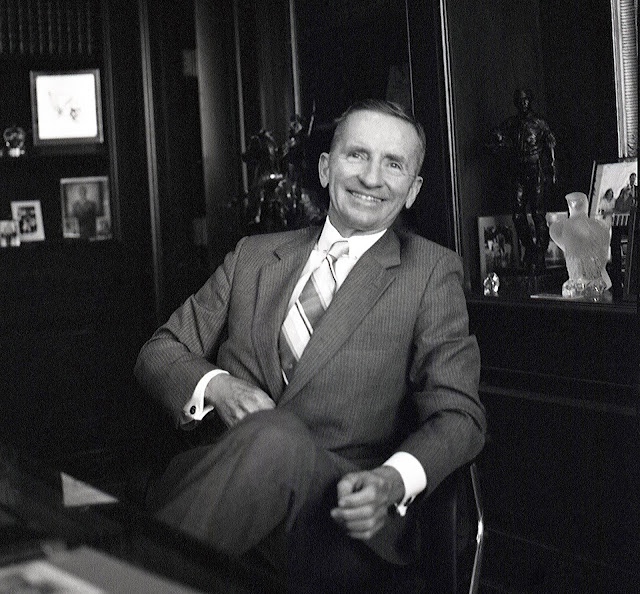
William R. Staats & Co., Continued The Entry of Ross Perot, Continued Ross Perot in his office, by Allan Warren. In January 1971, duPont family members led by Anthony duPont, Edmond's son, tried to withdraw their capital from the firm. Perot was outraged. He said, "[The duPont family] knew I wanted to do this thing in the national interest. They would have been wiped out if I hadn't come in, but when I did they looked on me as someone pouring money into a funnel so they could take it out at the bottom." As The New York Times stated, "The Perot group, of course, had no intention of keeping its own money in the firm, inasmuch as the group's funds had kept duPont afloat. The duPont family interests and other principals would not have had anything to consider pulling out, had the Perot group not prevented the firm's failure." The NYSE leadership became intermediaries in the conflict and tried to impress upon the duPont family interests the...

Francis I. duPont & Co. Genealogy: Part XIII

Image
William R. Staats & Co., Continued F.I. duPont, Glore Forgan & Co. (1970) Wall Street was particularly interested in the fate of the new firm because duPont, Hirsch and Glore Forgan were all considered "substantial houses prior to the merger, but all were experiencing some kind of financial difficulty." The New York Times reported, "Many of Wall Street's managers believe mergers will provide the key to that future, since they theoretically will enable brokerage houses to find economies of scale that were unavailable to them before F.I. duPont, Glore Forgan & Co. probably will be a case study for the whole industry." The hope was that the merger would diversify the firm's services and its geographic footprint while also cutting costs. Hirsch & Co. was known to have "retail strength in metropolitan New York and Florida as well as Europe" while "Glore was a major-bracket investment banking house with a retail system largely ...

Francis I. duPont & Co. Genealogy: Part XII

Image
William R. Staats & Co., Continued William R. Staats & Co. (1951) William R. Staats & Co., Inc. In 1947, Jardine stepped down from the presidency and became chairman of the board. He was succeeded by Donald Royce, a former vice president and manager of the southern California branch of Blyth & Co., Inc. , a San Francisco firm founded in 1914. In 1951, William R. Staats & Co., Inc. became a partnership, and Jardine, Royce and other Staats executives became general partners. (Jardine died in 1956 but his son, John Earle Jardine, Jr. (1899-1972), joined the firm in 1922.) By that time, the firm has offices in six California cities and Phoenix, Arizona, and a correspondent relationship with Clark, Dodge & Co. of New York. In 1963, Staats & Co. took over the San Francisco firm of Hooker and Fay, Inc. (founded 1938) and Charles W. Fay, the president of Hooker & Fay, joined the firm. Staats & Co. went back to being a corporation by 1964, the year it en...

Francis I. duPont & Co. Genealogy: Part XI

Image
William R. Staats & Co. Ford Motor Company Syndicate #76 Founded 1888*, Pasadena, California Origins William R. Staats (1867-1928) was the descendant of Major Abraham Staats (1618-1683), a Dutch immigrant who came to the New World in 1642, and the son of a minister. In 1886, Staats traveled to Pasadena, CA from his home in Glastonbury, CT. Just 19 years old, Staats had been suffering from a lung illness for three years and had tried and failed to regain his health in Florida. His parents were advised by Dr. Alfred Loomis, a New York lung specialist, that he might survive his illness if he made it to California. Staat's former teacher at the Wesleyan Academy (MA), Prof. Charles M. Parker, had traveled to California to recover his own health and had settled in Pasadena. With the financial assistance of his father's congregation, Staats made the journey to Pasadena and boarded with a Mr. Meharry, who was secretary of the Lake Vineyard Land and Water Company at which Parke...

Francis I. duPont & Co. Genealogy: Part X

Image
Glore, Forgan & Co., Continued Glore, Forgan & Co. (founded 1937, Chicago) During the mid-20th century, Glore, Forgan & Co. went through a generational transition, and, like many other banking partnerships, it did so under the shadow of a worldwide conflict. Like many in the investment community, the partners of Glore, Forgan & Co. also interrupted their work to serve in World War II. Charles Glore, who had also served in World War I under General Pershing, became the Illinois chairman of the British War Relief Society . J. Russell Forgan served in the Office of Strategic Services "collecting, assessing and disseminating information about German defenses and troop positions before the Normandy landings." Charles F. Glore died in 1950, but his two sons  –  Charles F. Glore, Jr. (1920-1976), who studied at Babson Institute, and Robert Hixon Glore (1923-2008), a Wharton graduate (1948)  –  joined Glore, Forgan & Co. in the postwar period. J...

Francis I. duPont & Co. Genealogy: Part IX

Image
Glore, Forgan & Co., Continued Glore, Ward & Co. (founded 1920, Chicago) Marshall Field, Glore, Ward & Co. (founded 1920, Chicago) Field, Glore & Co. (founded 1928, Chicago) Born in Arkansas, Charles F. Glore (1886-1950) was raised by his mother, Laura, an Illinois native, who worked in a factory as a bookkeeper. Glore studied at the Lewis Institute and the University of Chicago. He later worked at A.B. Leach & Co. (founded 1906, Chicago), a Chicago bond house, where he rose to the position of vice president. In 1920, he created a partnership with Pierce C. Ward and Allen L. Withers, who had both been managers of Goldman Sachs & Co.'s Chicago office. The New York Herald stated, "It is announced that a new investment banking house has been organized by several men for many years prominently identified with the investment banking and commercial paper business in Chicago." The firm was called Glore, Ward & Co. The reputation of the fir...

Francis I. duPont & Co. Genealogy: Part VIII

Image
Glore, Forgan & Co. Ford Motor Company Syndicate #9 Founded 1937, Chicago Origins The son of a golf club manufacturer, David Roberston Forgan (1862-1931) was born in St. Andrews, Scotland. When he was 15 years old, David started working as a messenger boy in the Clydesdale Bank in his hometown. David was preceded in the field of banking by his older brother, James B. Forgan (1852-1924), who worked with the Royal Bank of Scotland and then with the Bank of British North America , which stationed him in Canada and the United States. James then worked at the Bank of Nova Scotia before moving to Minneapolis to create an agency for the bank in that city. In 1892, he moved again, this time to Chicago where he became the first vice president of the First National Bank of Chicago . He was named president in 1900. David Robertson Forgan. Courtesy of Library of Congress . David Forgan followed in his older brother's footsteps, and in 1880, he immigrated to Canada, w...

Francis I. duPont & Co. Genealogy: Part VII

Image
Hirsch & Co., Continued Hirsch, Lilienthal & Co. (founded 1911, New York) In 1911, Charles S. Hirsch joined forces with Joseph Leo Lilienthal (1880-1936) to create the firm of Hirsch, Lilienthal & Co. A graduate of Harvard (1902), Lilienthal was the son of Philip Nettre Lilienthal (1849-1908), a San Francisco banker. Born in New York and raised in Cincinnati, Philip was the son of Max Lilienthal , a respected Jewish rabbi and Bavarian immigrant. At the age of 18, Philip joined the firm of J.W. Seligman & Co. In 1869, the Seligmans sent him west to head up a San Francisco branch. In 1873, he set out on his own and founded the Anglo-Californian Bank. He married Isabella "Bella" Seligman (1859/1860-1906), the daughter of Joseph W. Seligman , who was the founder of the House of Seligman, in 1879. Born in 1880, Joseph Leo Lilienthal was Bella and Philip's oldest son. Before he joined in partnership with Charles Hirsch, Joseph worked at Goldsmith & Co...

Francis I. duPont & Co. Genealogy: Part VI

Image
F.I. duPont, Glore Forgan & Co. (1970) In the early post-war period, F.I. du Pont's expansion was considered a sign of the growing economy and the firm's strength among its peers. By the early 1960s, however, the firm's mergers reflected a more difficult business environment, a desire to cut operating costs and the need for more capital. In 1970, Francis I. duPont & Co. merged with two firms, Glore Forgan Staats, Inc. (founded 1965, New York) and Hirsch & Co. (founded 1944, New York), in "one of the largest consolidations in Wall Street history." The name of the new firm was F.I. duPont, Glore Forgan & Co., though a new corporate subsidiary called DuPont Glore Forgan, Inc. was also created to conduct investment banking activities. Wallace C. Latour, the senior managing partner of duPont, became a managing director. J. Russell Forgan, Glore Forgan & Co.'s founder, was the honorary chairman of the board of directing partners. Edmond du Pon...

Francis I. duPont & Co. Genealogy: Part V

Image
A.C. Allyn & Co., Continued F.I. duPont & Co. (1963) F.I. du Pont, A.C. Allyn, Inc. (subsidiary, founded 1963, New York) In 1963, while Allyn Jr. was still head of the White Sox and three years after Allyn Sr. died, the Allyn brothers decided to merge A.C. Allyn & Co. with the firm of Francis I. du Pont & Co. (founded 1931, New York), whose senior partner, Edmond du Pont , was the son of the founder. The newly merged firm became the second largest brokerage firm in the United States, second only to Merrill Lynch, Pierce, Fenner & Smith, Inc. with "assets of more than 300 million dollars and a net worth in excess of 35 million dollars." The new firm had more than 110 offices and almost 3,000 employees. It retained the F.I. duPont name, but an affiliate named F.I. du Pont, A.C. Allyn, Inc. (founded 1963, New York) was created as a corporate underwriting division. The Allyn brother joined the duPont firm as partners. Given Francis I. duPont's ear...

Francis I. duPont & Co. Genealogy: Part IV

Image
A.C. Allyn & Co., Continued A.C. Allyn & Co., Inc. (founded 1912, Chicago) A.C. Allyn & Co. (founded 1948, Chicago) In 1928, Arthur Allyn made the fortuitous decision to liquidate much of the firm's debt, and A.C. Allyn & Co. survived the crash that followed. That year, in 1929, Allyn created Artnell, an investment company named after him and his wife, Nelle Musick. (They married in 1913.) The Allyns had two sons, A.C. Allyn, Jr. and John W. Allyn, who both joined the family firm. Arthur C. Allyn Jr. (1913-1985) studied at Dartmouth College and did not initially go to work for the family firm. He worked as "a biologist for the California Packing Company in San Francisco from 1938 to 1945," and served as president of the Pacific Vinegar Company until 1949, when he moved back to Chicago to become a partner in A.C. Allyn & Co. and president of Artnell Co., then a holding company. John W. Allyn (1917-1979) was a graduate of Lafayette University ...

Francis I. duPont & Co. Genealogy: Part III

Image
A.C. Allyn & Co. Ford Motor Company Syndicate #32 Founded 1921, Chicago Origins Born in Hopkins, MO, Arthur Cecil Allyn (1887-1960) was the son of Frank Egbert Allyn (1855-1919) and the former Mary Hettie David. Allyn traced his lineage back to a Thomas Allyn from Connecticut, who fought in the American Revolution. His father was a commercial trader in the hardware business. Allyn grew up in Nebraska, Illinois, Kansas and Missouri, and he studied at the University of Chicago. In 1906, he had to leave school when his father became ill. After working as a buyer for sporting goods in a hardware company, Allyn moved from St. Louis to Chicago in 1908. He said, "I decided if I could make money in sporting goods I could make money in a business that handled money." Allyn was introduced to Harold L. Stuart , a member of the bond firm N.W. Halsey & Co., by the cousin of General Charles G. Dawes (1865-1951), William R. Dawes, who was an acquaintance of his father....

Francis I. duPont & Co. Genealogy: Part II

Image
Francis I. du Pont & Co. Ford Foundation Syndicate #36 Founded 1931, New York According to The Evening Journal , Francis I. du Pont & Co. instituted innovative business practices for the securities business, translating F.I.'s practice for doing research from E.I. du Pont de Nemours & Co. to his new firm and also introducing marketing and advertising in "mass circulation magazines and newspapers." F.I. said, "We felt that the future of the stock market lay in broadening its base by bringing in the small investor." Several of F.I. du Pont's earliest partners were his sons and his sons' associates. His son, Edmond (1906-1996), was born in Delaware and educated at Princeton and Oxford. Edmond joined the firm in 1932 and by the early 1940s, was directing "the firm's record-keeping toward automation." Through these efforts, the firm became a pioneer "in the use of automated equipment to cope with the involved figuring o...

Francis I. duPont & Co. Genealogy: Part I

Image
In 1974, DuPont Walston was liquidated. At that time, the histories of Francis I. duPont & Co., Glore Forgan & Co., Wm. R. Staats, Inc., Hirsch & Co., A.C. Allyn & Co. and Walston & Co., six members of the Ford Motor Company Syndicate, came to an end. Over the next several posts, we will take a closer look into the histories of each of these firms and how they all eventually became a part of DuPont Walston. Origins Eleuthére Irénée du Pont (1771-1834) founded his namesake firm, E.I. du Pont de Nemours & Co., a chemical manufacturer, in 1802. A French immigrant and the son of a watchmaker, E.I. du Pont demonstrated an interest in the study of gunpowder from a young age. His mentor was Antoine Lavoisier , the French chemist. In 1799, in the aftermath of the French Revolution, du Pont's family immigrated to the United States. Though he returned briefly to France in 1801, du Pont settled in Delaware, where he founded the first of many gunpowder mills. ...

Joseph Louis Searles III: The First African American Member of the New York Stock Exchange

“The New York Stock Exchange is not a cold, heartless organization. It isn’t eighths and quarters on decimal points—it’s people.”  - Robert Lester Newburger Born in Germany, Morris Newburger (1834-1917) immigrated to the United States in 1854. His father was a teacher and descended from a family of rabbis. In Germany, Morris worked in the dry goods business. In the United States, he lived in New York, in the South, in Cedar Rapids, Iowa, and Rock Island, Illinois, before settling in Philadelphia in 1963. In 1862, he married the former Betty Hochstadter, and he entered into a partnership with his brothers-in-law, Adolph, Albert, and David Hochstadter, creating the firm of Newburger & Hochstadter, wholesale clothing traders. Morris became the president of the Mechanics National Bank in Philadelphia and founded the clothing manufacturer, Morris Newburger & Sons with his sons. He and his wife had seven children: five sons, Samuel M. Newburger, Alfred H. Newburger, Frank...

Josephine Holt Perfect Bay: The First Woman to Head a NYSE Member Firm

Image
Josephine Holt Perfect Bay was the first woman to the head a member firm of the New York Stock Exchange and is the only female executive in the Ford Motor Company Syndicate. In 1940, Charles U. Bay became senior partner of A.M. Kidder & Co. In 1946, however, he became Ambassador to Norway under President Harry Truman and took a leave of absence from the firm until 1953. In 1955, when Bay died, he owned about 71% of the firm’s stock. After his death, in 1956, Charles’s wife, Josephine Perfect Bay, assumed his position as the president and chairman of A.M. Kidder & Co., Inc. because the New York Stock Exchange rules required any stockholder who owned “more than 45% of a member company’s shares” to either sell or “take an active part in the firm.” Born in Iowa, Josephine Holt Perfect Bay (1900-1962) was raised in Brooklyn. The daughter of Otis Lincoln Perfect (1860-1919), a real estate broker, she was a graduate of the Brooklyn Heights Seminary (1916) and studied...